Question
Gurudev, pranam 🙏🙏
Often, people dressed as saints or ascetics come into our streets asking for donations for temple construction, ashram construction, or other religious works. But we do not know what they actually do with that money. It is also possible that someone may misuse the funds.
In such a situation, when they come to our doorstep, it becomes difficult to refuse them, because there is also a saying— “Who knows, Narayana may come to us in some form.”
Because of this, a great state of confusion arises.
What should we do in such circumstances?
Please guide us. 🙏🙏
Answer
According to the Shrimad Bhagavad Gita, charity is not an optional social activity; it is an essential and sacred duty.
Charity purifies the inner being of a person and brings balance to life.
The Necessity of Charity — The Clear Teaching of the Gita
Lord Shri Krishna says:
“Yajña-dāna-tapaḥ-karma na tyājyaṁ kāryam eva tat |
Yajño dānaṁ tapaś caiva pāvanāni manīṣiṇām ||”
(Bhagavad Gita 18.5)
Meaning:
Acts of sacrifice, charity, and austerity should not be given up.
They must certainly be performed,
for sacrifice, charity, and austerity are actions that purify even the wise.
This verse clearly shows that charity is not merely a means of helping others,
but a path for one’s own purification and upliftment.
How Much Charity Should One Give?
The Lord has not specified an exact amount of charity.
However, based on scriptural tradition and practical experience—
Donating about 10% of one’s income or profit is considered a balanced and appropriate standard.
Even today, many traders and mindful householders follow this principle.
However—
Those who are not accustomed to giving charity may begin with 2% or 5%.
Gradually, it is appropriate to take it to at least 10%.
An important practice is to set aside something every single day
and put it into a charity box or piggy bank at home.
This creates a daily habit of virtue.
The Fruit of Charity
It should be clearly understood that—
If there is one action that increases happiness, peace, and prosperity
both in this life and in the life to come,
it is charity, altruism, and helping others.
Charity does not change only the life of the receiver;
it also transforms the life of the giver.
Types of Charity — The Gita’s Discernment
Regarding to whom charity should be given and in what manner,
Lord Shri Krishna has given a very clear classification in the Gita.
The Three Types of Charity
“Dātavyam iti yad dānaṁ dīyate’nupakāriṇe |
Deśe kāle ca pātre ca tad dānaṁ sāttvikaṁ smṛtam ||”
(Gita 17.20)“Yattu pratyupakārārthaṁ phalam uddiśya vā punaḥ |
Dīyate ca parikliṣṭaṁ tad dānaṁ rājasaṁ smṛtam ||”
(Gita 17.21)“Adeśa-kāle yad dānam apātrebhyaś ca dīyate |
Asatkṛtam avajñātaṁ tat tāmasam udāhṛtam ||”
(Gita 17.22)
Meaning:
Sattvic charity — Charity given as a duty, to a worthy recipient, at the proper time and place, without any expectation.
Rajasic charity — Charity given with the desire for return, fame, or out of ego.
Tamasic charity — Charity given to an unworthy person, at an improper time or place, without respect.
Among these, sattvic charity alone is considered superior.
The Proper Way to Give Charity
According to the spirit of the Gita—
Charity should be given with respect.
One should inwardly regard the recipient as a form of God.
Charity should be offered as a dedication to God, not with ego.
One should avoid the feeling, “I have given a lot of charity.”
Charity should not be displayed or publicized.
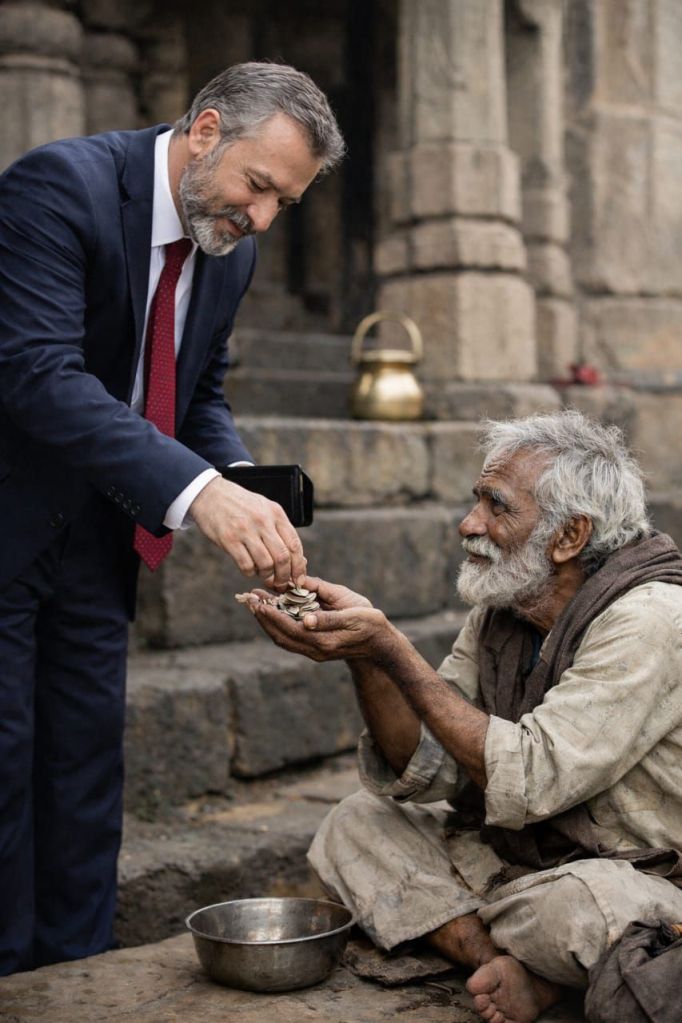
Even if charity is given to a beggar, it should be done with folded hands,
so that the person does not feel humiliated by poverty and instead experiences dignity.
Charity should never be given by destroying someone’s human self-respect.
Should We Give Charity to an Unknown Person or One Dressed as a Sadhu?
Now let us come to your main question.
If a person dressed as a sadhu comes to your door and you do not have clear information about him, then—
- First, respectfully offer him some water.
- Calmly ask a few questions about his purpose.
- If even a little credibility is established, it is appropriate to give a small amount of charity.
Even if it later turns out that the money was misused—
You will still receive the merit of charity,
because you made a sincere effort to assess the recipient from your side.
However, large donations should always be made
only after prior selection, examination, and trust.
Prior Selection of Worthy Recipients
It is best that—
You keep a list in advance of genuinely needy sadhus or virtuous individuals.
Similarly, select reliable institutions engaged in good work.
Reserve a fixed portion of your charity funds for them.
The Special Importance of Donating Sacred Scriptures
A portion of one’s charity should certainly be used
for the distribution of the Shrimad Bhagavad Gita.
In the light of Gita 18.69, this makes one extremely dear to God.
Selfless distribution and propagation of the Gita is a precise path toward liberation.
A person who is interested in spiritual knowledge is a worthy recipient of Gita-dāna.
But it should be given after clearly asking—
Will you read the Gita for at least 15 minutes every day?
Take this promise from them.
Similarly, donating—
Ramcharitmanas
Shrimad Bhagavata Purana
is also extremely useful and beneficial.
Conclusion — The Balance of Compassion and Discernment
For those about whom you do not have complete information,
set aside a small portion of your charity funds,
so that compassion remains alive and discernment also stays protected.
This is the balanced path shown by the Gita.
Hari Sharanam.

 Swami Brahm Bodhi
Leave a comment