5 December 2025
When I arrived in New York yesterday and reached my friend Mr. Rahul’s home in Manhattan from John F. Kennedy Airport, it was already quite late. It was time to sleep. After a short conversation, we both went to our respective rooms.
This morning, after waking up, I walk into the living room. It is a large hall that includes the kitchen, the dining space, and an additional seating area.
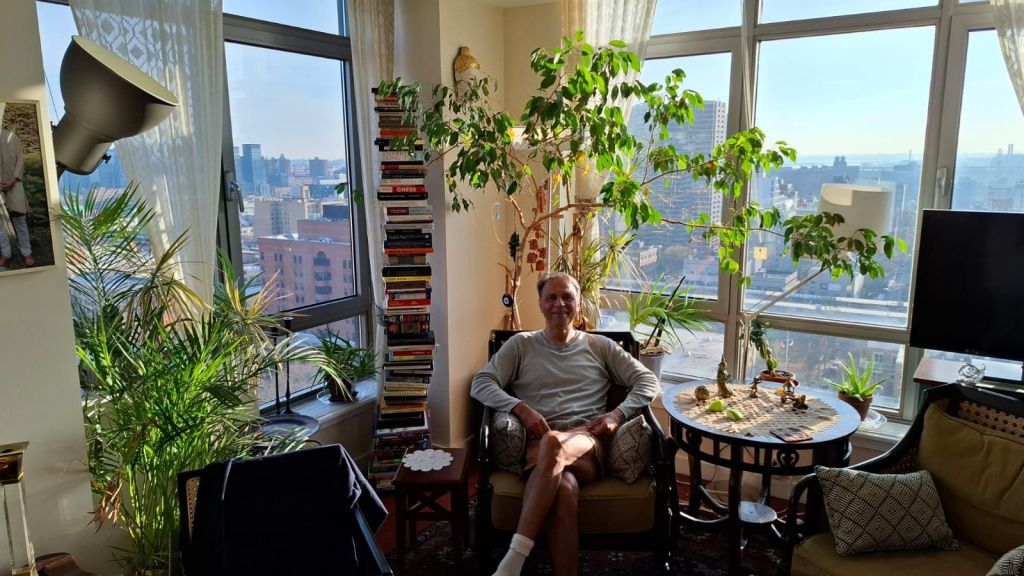
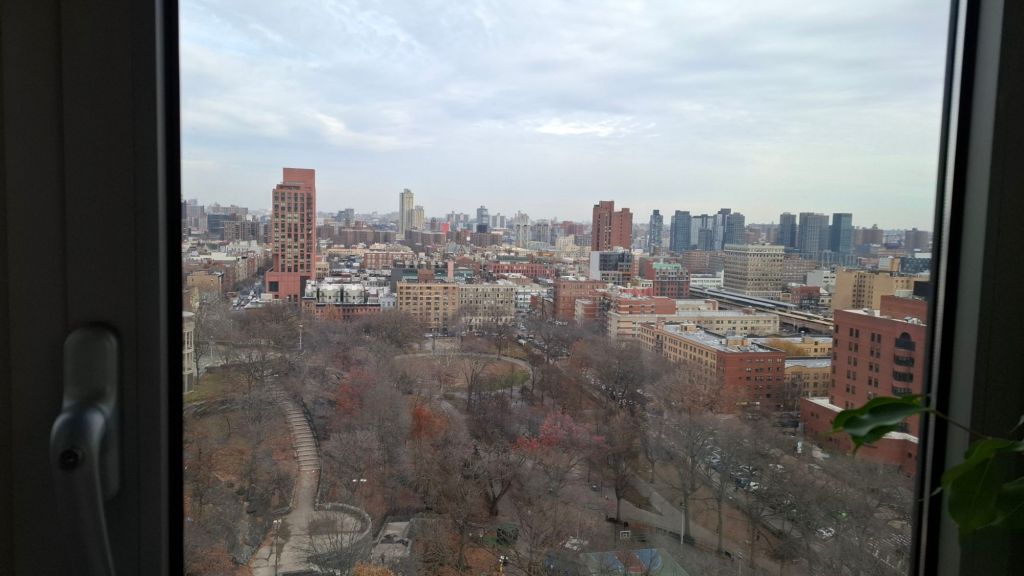
The living room—what we in India also call the drawing room—has two outer walls fitted with large glass windows through which the dense buildings of New York City can be seen. My friend’s apartment is on the 19th floor of a tall building, so the city’s architecture is imprinting itself on my mind for the first time.
New York’s architecture is very different from that of London. At first sight, it reminds me of Patna in India—small and large buildings of varied styles standing close to one another, without the harmonious aesthetic that London naturally offers. The sky too lacks London’s soft, grey-white chains of clouds.
Here a small house, next to it a large one; somewhere red brick, somewhere yellow; somewhere exposed brick, somewhere fully plastered. For a mind arriving from London, this scene is almost an aesthetic jolt. In London’s quiet residential areas, most homes are exposed brick, of similar height and design; no tall structure suddenly rises among them.
Here, it seems as if everyone has built whatever they wished.
As I let my eyes wander across the horizon, the Statue of Liberty appears, holding aloft the torch of freedom—like a semi-transparent image. For a moment, it seems as if her lips are moving, and a voice echoes in my ears:
“I see the surprise on your face. You are comparing England with America. England is a still country; America is a running one.
We do not wish to pause, spellbound by beauty. For us, beauty is secondary to utility.
The use of land, the use of sky—these are our primary values.
Our highest value is freedom. This torch symbolises that freedom.
Here, a person lives largely as he wishes.
Freedom to say anything, to do anything—you will see it at every step. Prepare yourself for it; only then will you understand our spirit.”
Before I can respond, the image of the Statue of Liberty dissolves into the sky and becomes formless.
I cast a deep glance across Rahul’s living room. A beautiful, serene space with an elegant sense of design. Nothing extravagantly expensive, yet the walls carry large oil paintings that reveal someone’s deep attraction to art.
This home belongs to a couple who, though from a middle-class background, possess a refined taste for beauty and grace. Mr. Rahul was a senior IPS officer, who left his service to join the United Nations, and has lived here since then. His wife is also employed with the UN; she is still in service, while Mr. Rahul has now retired.
As I stand admiring the paintings on the walls, Rahul walks in. He asks me to sit on a single-seater sofa in one corner. Above it stands a large potted plant, shaped almost like a Bodhi tree, and nearby hangs a picture of the Buddha. Perhaps this is where he sits and reads.
I think to myself: the sofa is inviting, but when I stand up, the branches might brush against my head—an experience I have had many times before. So instead I sit on the sofa beside it. Rahul takes a seat across from me on a longer sofa.
On two sides of the room stand tall towers of books. These are shelves where the books have not been placed vertically but horizontally—stacked from bottom to top—so that the piles look like two towers and the bookshelves themselves disappear from sight.
A remarkable sense of aesthetics!
When I praise the room’s simplicity and artistic decor, Rahul tells me that the entire arrangement is the creation of his wife, Meena. She planted the Bodhi-like tree and placed it above the reading sofa where Rahul usually reads.
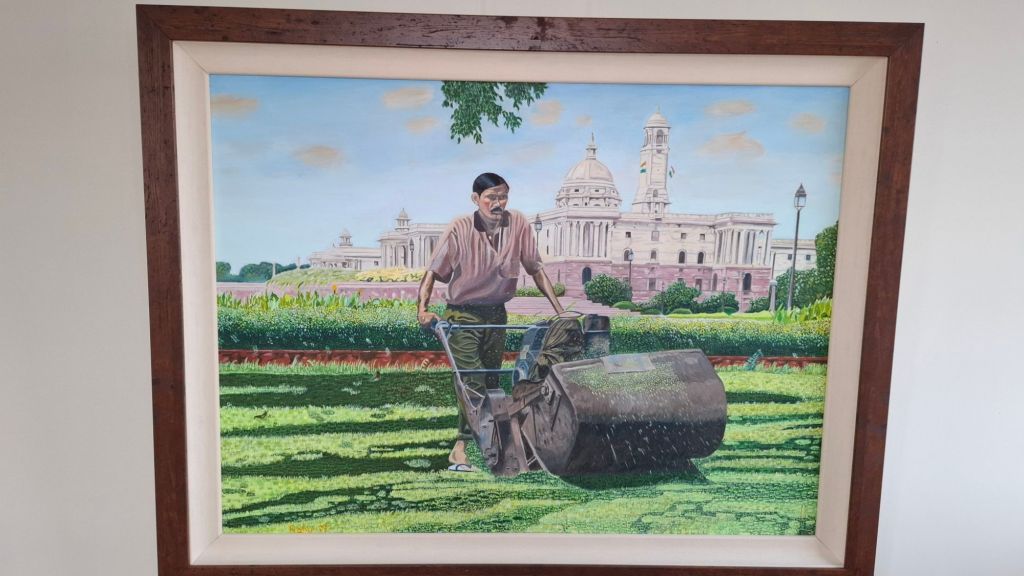
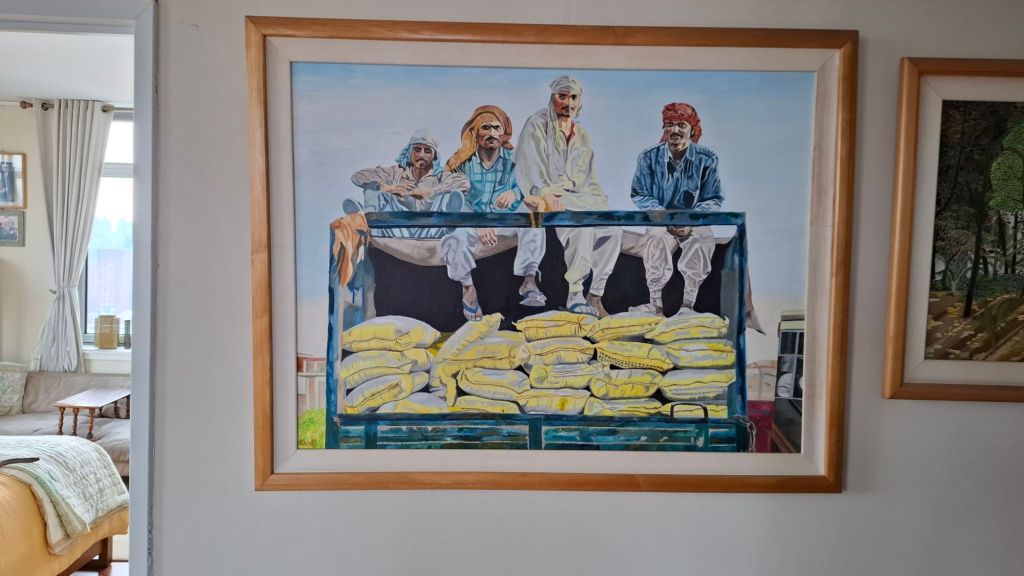
Only the oil paintings on the walls are Rahul’s own work, though their placement is decided entirely by Meena.
Rahul laughs and says that every decision about what object will be placed where, and in which colour, is made by his wife. I easily recognise the universal husbandly sentiment hidden in his tone, and reassure him that this is not his personal experience alone—it is a universal one.
As for the paintings, I have not seen so many beautiful oil paintings made by a man in any home. They carry not only artistic skill but deep sensitivity—especially toward the working class.
One painting shows a labourer cutting grass with a machine in front of Delhi’s North Block; another shows workers sitting in a row, their feet resting on cement sacks. A painting in the corridor depicts a young Black African labourer.
In recent years, Rahul has developed a deep inclination toward spirituality—which is what connects us. For many years he has been inviting me to New York, urging me to begin my spiritual work here as well. It is on his insistence and affection that I have come, and I am now staying with him.
A human being contains many layers that remain unknown for years. In the Hyderabad Police Academy, Rahul was known as a “brown Englishman”—one of the fastest speakers of English. People even called him a coconut—brown on the outside, white on the inside.
But within him lived an artist and a spiritual seeker—something neither I nor anyone else realised, though I was one of his closest friends in the Academy.
Sitting in the living room, I share with him my experiences from London, and then speak of my plans to expand my mission in America.
Our conversation slowly begins to gather momentum…
 Swami Brahm Bodhi
Leave a comment