4 November 2025.
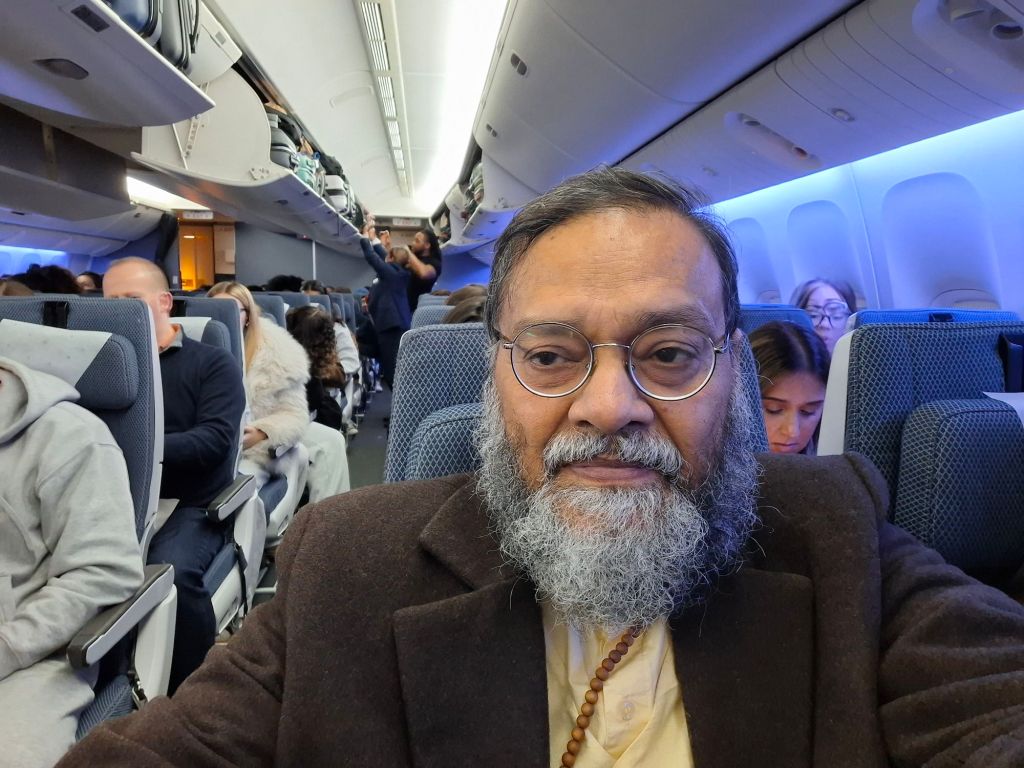
After bidding farewell to London, and completing the immigration process and security checks, I enter the large British Airways aircraft.
The aircraft is divided into three sections. As one enters, the highest category (Business Class) appears first, where the space equivalent to two seats is designed like a small personal office—comfortable seating and, beside it, a neat platform to place a laptop and other items.
After that comes the middle section, and finally the Economy Class.
The Puranas, the Ramayana and other ancient texts mention aerial travel, but the use of those aircraft was limited even among the most privileged individuals. No person sitting in this aircraft today would have been allowed to sit in those ancient aircraft. This capability has been given to human beings only by science and technology.
But science has also brought with it many other things—whose consequences humanity has had to suffer. The reason is simple: if wisdom does not accompany knowledge, knowledge too becomes dangerous.
At this moment I recall the essay “Knowledge and Wisdom” by Bertrand Russell, which I had read during my student days. In today’s education system, the discussion on ‘wisdom’ has receded far behind; only ‘knowledge’—which, in reality, is merely ‘information’—has come to dominate.
The Bhagavad Gita is a great source of wisdom.
The aircraft is awaiting takeoff. Meanwhile many thoughts arise in the mind.
How did science progress so rapidly in the past five or six centuries?
Why was all this not possible earlier, when—as scientists say—the human brain, even two million years ago, was almost the same in size as it is today?
In other words, the hardware existed; only the software that is installed on this hardware today was absent.
In place of free and impartial thinking, another software prevailed—belief in every statement of religious books without any inquiry or examination. This blind faith shackled human reasoning and research capability for thousands of years.
Those whose thinking broke free from the chains of blind belief—primarily the people of Europe—gained a new strength. This was not spiritual power; it was the strength of independent intellect.
And with this independent thinking, they were able to discover the laws of nature. On the basis of those very laws, aircraft capable of carrying hundreds of people at a time could be built.
Aircraft fly only because human beings identified the natural laws of aerodynamics and applied them to machines.
In London I observed that most temples, mosques and gurdwaras being established now are created by purchasing church buildings where Christians no longer come to pray.
And it is equally true that these very societies—who no longer attend church—are the same societies that created this aircraft and thousands of other instruments through which human beings began to gain mastery over nature.
Conversely, the communities that clung blindly to their religious books are almost invisible in the list of scientists. They too are seated in this aircraft, but they had no contribution in building it.
In Africa, Boko Haram issued a fatwa that schools must not teach that rain occurs due to evaporation—because this did not match the statement in their scripture. When schools did not follow this order, they killed almost five thousand children, according to various reports.
On one side is such blind faith in a religious book, and on the other side is the extreme reaction of discarding an entire book merely because some of its statements have been scientifically disproven—both are extreme responses of the human mind.
The Gita saves one from both.
It says that without faith, knowledge cannot be attained—
“śraddhāvān labhate jñānam…” (Gita 4.39)
Meaning: Only a faithful and disciplined person attains knowledge.
And it gives another warning—
“ajñaś cāśraddadhānaś ca saṁśayātmā vinaśyati.” (Gita 4.40)
Meaning: A person who is ignorant, faithless, and full of doubt is destroyed.
But it must be remembered that both these verses apply to spiritual knowledge, not to worldly science. Even in spiritual matters the Gita never obstructs human thought.
For the Gita also presents a new dimension in which God Himself grants human beings the freedom to think—
(Gita 18.63)
“iti te jñānam ākhyātaṁ… vimṛśyaitad aśeṣeṇa yathecchasi tathā kuru.”
Meaning: I have told you my view; now reflect on it thoroughly and then act as you wish.
This is a clear declaration of freedom of choice—and also a reminder that before accepting something as divine revelation, one must examine whether it is truly divine, or whether some human beings may have inserted their own interests in the name of God.
Therefore, acquire as much scientific knowledge as you wish, but do not fall into blind belief—retain your discernment. Avoid such sweeping generalisations as “Whatever is not in the Vedas is nowhere.”
The balance of intellect and faith, knowledge and discernment—such a framework I have not seen elsewhere. Aside from this, nowhere else except the Gita have I seen such clear statements: that there are many paths to reach God (“ye yathā māṁ prapadyante…”), that nonviolence is a divine virtue and violence an asuric trait, that war is the last resort, that the same God resides as the Self within all beings, all humans…
This is why I have embarked on a global journey to propagate the Gita—to prepare the ground, plant seeds, and build teams in various countries.
When the seeds sprout, I shall return in the next journey to nurture the growing plants.
My chain of thoughts suddenly breaks when the flight attendants announce that the aircraft is about to take off and seat belts must be fastened.
I fasten my belt and gently fold away the kite of thoughts, placing it in a corner of the mind.
As my thoughts halt, the aircraft itself gathers speed on the runway.
 Swami Brahm Bodhi
Leave a comment