Travelogue – 6
First Encounter with the Brahma Kumaris in London
One of the principal purposes of my visit to England was Interfaith Dialogue — to foster understanding among diverse religious and spiritual traditions, to build bridges of harmony, and to explore new possibilities of collaboration. Today, a beautiful first step was taken in that direction.
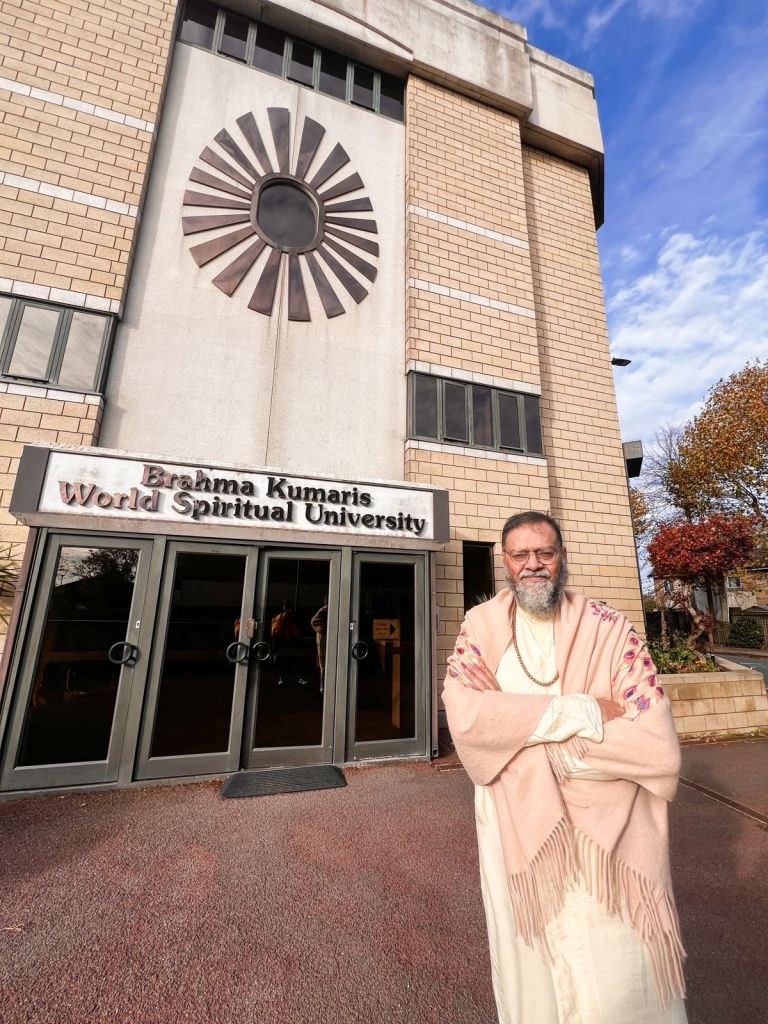
We visited the Brahma Kumaris World Spiritual University at the Global Cooperation House in London. The regional head, Sister Gemini, along with her associates Sister Charu, Sister Kim, Sister Kalpana, and Sister Dipti, welcomed us with warm affection.
Even during our initial conversation over the phone, they had lovingly insisted that we share lunch with them — and indeed, they were waiting for us when we arrived.
The meal was delicious, sattvic, and absolutely pure — prepared without onion or garlic, and without any food sourced from outside. They told us that in their kitchen, nothing cooked — not even sweets or bread — comes from elsewhere. Everything is prepared within the ashram itself. This discipline of self-reliance and purity gives the community its distinct aura.
After the meal, our dialogue began. I briefly introduced my background and requested that, for today, I would rather listen than speak. They smiled and mentioned that they had already watched some of my talks and interviews online — the bridge of communication had, it seemed, already been built.
Sister Jaymini, who oversees the organization’s work across several countries, spoke in detail about the origin and philosophy of the Brahma Kumaris movement.
She explained that the institution was founded before India’s independence, in Hyderabad (Sindh) and Karachi. Since its ideas were unconventional — even revolutionary — it faced opposition, and eventually the headquarters were moved to Mount Abu. From there, the movement has quietly spread to nearly 8,000 centers across the world.
The essence of the organization, she said, lies in working with quiet dignity — serving humanity through spiritual practice, free from noise, propaganda, or ostentation.
The sisters seated with us wore a special locket that all Brahma Kumari teachers wear. In its center was an image of Lord Vishnu, on one side Lord Shiva, and in place of Brahma, a portrait of Lekhraj Mahashay, their revered founder — lovingly known as Brahma Baba. His followers consider themselves his spiritual children; thus, the women are called Brahma Kumaris and the men Brahma Kumars. On the back side of the locket was an image of Lakshmi Narayan.
They believe that God — whom they call “Shiv Baba” — spoke to humanity through Lekhraj Baba, revealing divine wisdom for the upliftment of humankind.
I asked, “Was this divine speech ever compiled into a scripture?”
Sister Jaymini replied, “Not in a formal book. The words continue to live as the Murli (flute) — a daily message of about three pages, blending Hindi, Sindhi, and English expressions. Listening to it is an experience of the soul’s touch — just as the gopis were enraptured by Lord Krishna’s “murli” (flute), so too does a devotee find bliss in the Murli.”
She then read aloud a few lines from the Murli — her voice carried a depth of emotion that felt like a gentle invocation from the heart.
The Brahma Kumaris is indeed a unique spiritual experiment — not only in its inclusive spirit of interfaith dialogue, but also because it places the feminine principle at its very center.
Over 8,000 centers worldwide are led and managed primarily by women — a living testament to the reawakening of the divine feminine in our age.
Their London campus is serene and meticulously organized. There are no idols, no traditional temple structures — yet every hall radiates a quiet luminosity, centered upon the image of a point of light, the symbol of the soul and the Supreme.
Sister Kim, an English woman, shared her own story — that when she was nineteen, someone handed her a Bhagavad Gita and said, “Read this once; it will change your life.”
It did. That was the turning point of her journey.
Today, she is a senior member of the community — serene, content, and deeply fulfilled.
Sister Kim also guided us through the entire complex — the seminar halls, meditation rooms, and the auditorium. The meditation room, with a single luminous point of light at its center, radiated an ineffable peace. She also told us about their beautiful retreat center in Oxford.
The entire institution exudes a sense of discipline, grace, and purity that touches the heart.
Brahmacharya (celibacy) is one of the four cardinal vows of the community, not merely as a rule but as an integral part of spiritual practice.
As we took leave, they lovingly presented us with books, sweets prepared in the ashram, and other small mementos.
In return, I offered them an English commentary on the Bhagavad Gita penned by me.
Sister Kim and brother Emile accompanied us to the railway station — with the same simplicity, warmth, and quiet courtesy that mark their way of life.
The cleanliness, discipline, and spiritual dignity of the Brahma Kumaris left a deep impression upon me.
It was more than a visit — it was a communion of souls, where words were secondary and empathy was the true language.
 Swami Brahm Bodhi
Leave a comment